30 Ways Car Insurance Discounts: Every Premium way
Car insurance discounts is an essential expense for most drivers, but paying more than necessary doesn’t have to be part of the deal. Whether you’re a new driver, a long-time policyholder, a student, or a family with multiple vehicles, there are several ways to lower your car insurance premium without sacrificing the protection you need.
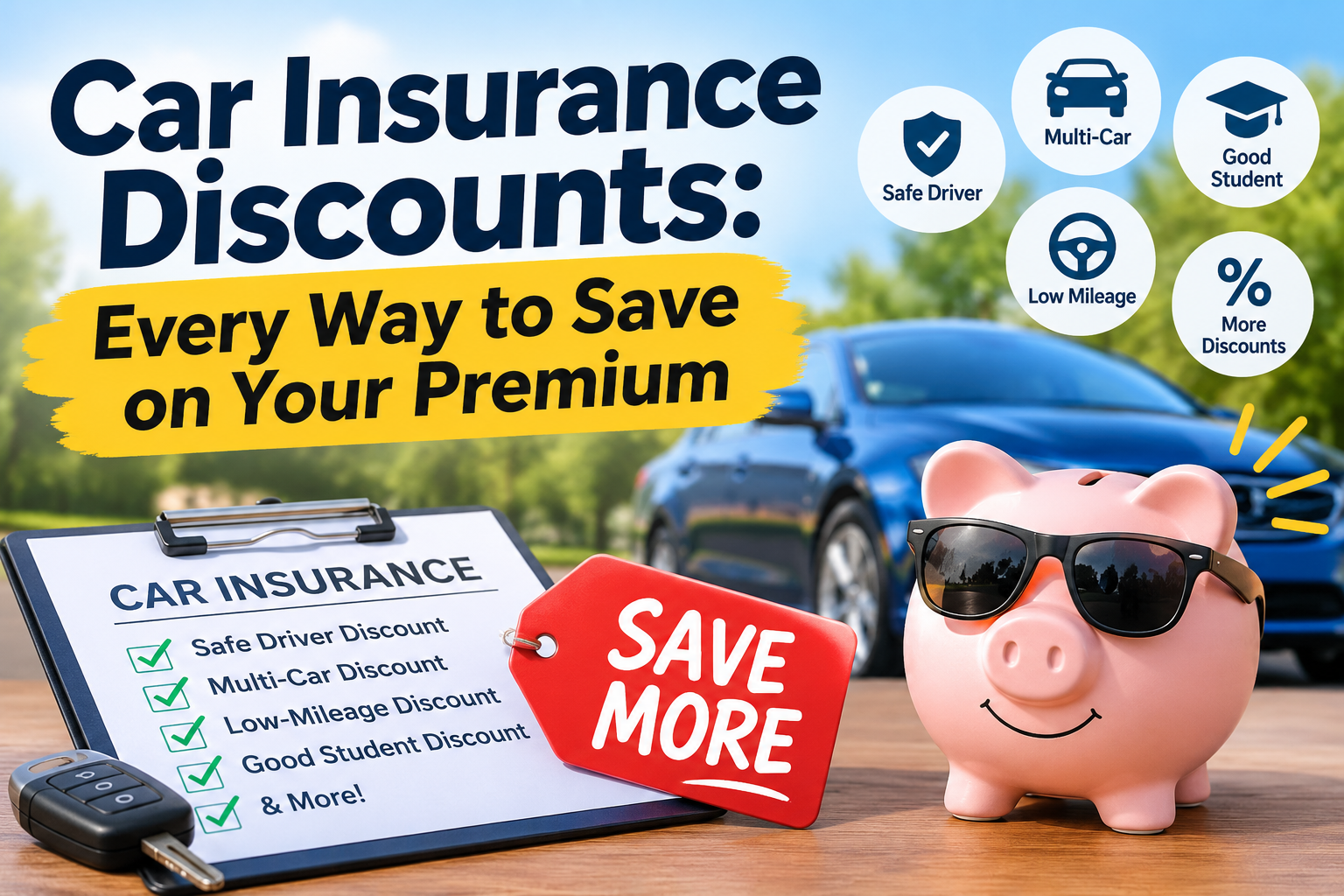
Car insurance discounts can help you save money based on your driving history, vehicle safety features, annual mileage, academic performance, policy choices, and payment habits. Some insurers also reward customers who bundle multiple insurance policies, complete defensive driving courses, or participate in safe-driving programs.
The challenge is knowing which discounts are available, how to qualify for them, and whether you’re already receiving every saving you deserve.
In this comprehensive guide, we’ll explore the major types of car insurance discounts, explain how to qualify, and share practical strategies to help you find affordable auto insurance in 2026.
What Are Car Insurance Discounts?
Car insurance discounts are reductions in your insurance premium offered by an insurance company when you meet specific eligibility requirements. Insurers use these discounts to reward behaviors, characteristics, and policy choices they associate with lower insurance risk or reduced administrative costs.
For example, a driver with a clean driving record may qualify for a safe driver discount. Someone who insures two cars with the same company may receive a multi-car discount. A policyholder who combines auto and homeowners insurance may qualify for a multi-policy discount.
Not every insurance company offers the same discounts, and eligibility requirements can vary by state, policy type, and individual circumstances.
It’s also important to distinguish a discount from a lower starting rate. A company with fewer advertised discounts may still offer a cheaper policy than a competitor with a long list of savings opportunities.
The goal is to find the lowest overall premium for comparable coverage—not simply the insurer offering the most discounts.
1. Safe Driver Discount
A safe driver discount is one of the most valuable car insurance discounts available to eligible motorists. Insurance companies may reward drivers who maintain a clean driving record over a specified period.
You may qualify if you have:
- No at-fault accidents for a qualifying period.
- No recent speeding tickets or serious traffic violations.
- A history of responsible driving.
- Few or no claims, depending on the insurer’s rules.
How to qualify for a safe driver Car insurance discounts
Drive responsibly, avoid distractions, follow speed limits, and maintain a record of safe driving. When comparing policies, ask how many years of driving history the insurer reviews and which violations affect eligibility.
Some companies distinguish between accident-free and violation-free driving, so a minor ticket may affect one discount without necessarily eliminating every available saving.
Best for: Drivers with several years of safe driving and few recent violations.
2. Claims-Free Discount
Some insurers reward policyholders who go a specified period without filing an insurance claim. This is known as a claims-free discount.
Although a claims-free history and a clean driving record often overlap, they are not necessarily identical. For example, you might have no traffic violations but still have filed a claim for a damaged windshield or weather-related vehicle damage.
Whether that claim affects your Car insurance discounts depends on your insurer’s policy.
Ways to maintain claims-free eligibility
- Drive carefully and maintain a safe following distance.
- Park in secure locations when possible.
- Take reasonable precautions against theft and vehicle damage.
- Understand your deductible before filing a small claim.
- Ask your insurer whether a particular type of claim affects your discount.
Never avoid reporting an accident or damage when your policy or applicable law requires you to do so. A small potential saving should not outweigh your contractual or legal obligations.
Best for: Drivers who have maintained a low-claim history over several policy periods.
3. Multi-Car Discount
If your household owns two or more vehicles, insuring them with the same company may qualify you for a multi-car Car insurance discounts.
This Car insurance discounts is particularly useful for couples, families with teenage drivers, and households with multiple cars.
How a multi-Car insurance discounts works
Suppose you insure two vehicles separately with different companies. Moving both policies to one insurer may reduce the combined cost if that company offers a multi-car discount.
However, the savings depend on the vehicles, drivers, coverage levels, and insurer’s underwriting rules.
Before combining policies, compare the total price for all vehicles, not just the premium for one car. Confirm that each driver and vehicle is listed correctly.
Best for: Families and households that insure multiple eligible vehicles.
4. Multi-Policy or Insurance Bundling Car insurance discounts
Bundling means purchasing more than one type of insurance from the same provider or affiliated insurance group.
Common combinations include:
- Auto and homeowners insurance.
- Auto and renters insurance.
- Auto and condominium insurance.
- Auto and umbrella liability insurance, where available.
A multi-policy discount may reduce the cost of one or more policies, making it a convenient way to manage insurance and potentially save money.
Is bundling always cheaper?
No. A bundle may look attractive because it advertises a discount, but another insurer could offer a lower auto premium and a lower home or renters premium separately.
Compare the combined annual cost of the policies, coverage limits, deductibles, exclusions, and service quality before switching.
Best for: Drivers who already need multiple types of Car insurance discounts and can obtain a competitive combined quote.
5. Low-Mileage Car Insurance Discounts
Drivers who spend less time on the road may qualify for a low-mileage Car insurance discounts because reduced driving generally means less exposure to traffic-related risks.
This option can be especially helpful for remote workers, retirees, occasional drivers, households with a second vehicle, and people who use public transportation regularly.
Insurers set their own mileage thresholds, so there is no single annual mileage limit that guarantees eligibility.
How to qualify for a low-mileage Car insurance discounts
- Estimate your actual annual driving distance.
- Check your odometer readings and maintenance records.
- Update your insurer if your commute becomes shorter.
- Ask whether the company offers a low-mileage or pay-per-mile policy.
- Report your mileage honestly and provide documentation when requested.
Some usage-based Car insurance discounts programs charge according to mileage and other driving factors, rather than applying a simple low-mileage discount.
Best for: Drivers who travel relatively few miles each year.
6. Usage-Based Insurance and Telematics Car insurance discounts
Usage-based Car insurance discounts programs use technology to evaluate driving patterns or mileage. Depending on the insurer, the technology may involve a smartphone app, a plug-in device, or connected-car technology.
These programs may assess factors such as:
- Hard braking.
- Rapid acceleration.
- Speeding or other driving indicators.
- Nighttime driving.
- Total mileage.
- Phone-related distractions.
A safe-driving program may reward participants with a Car insurance discounts, but the results depend on the insurer’s rules and the data collected.
What to know before enrolling
Read the program’s terms carefully. Some programs offer an enrollment discount, while others calculate savings after monitoring your driving. In some programs, driving behavior can also lead to reduced savings or higher rates, depending on state rules and the policy terms.
Consider privacy as well. Review what information is collected, how long it is retained, and how it may be used.
Best for: Drivers who travel predictable routes, drive relatively few miles, and are comfortable sharing driving data.
7. Defensive Driving Course Car insurance discounts
Completing an approved defensive driving course may help you qualify for an Car insurance discounts.
These courses teach drivers how to anticipate hazards, maintain safe distances, recognize road risks, and respond appropriately to changing traffic conditions.
Depending on your location and insurer, eligible courses may be available online or in person.
How to get a defensive driving Car insurance discounts
- Contact your insurance company before enrolling.
- Ask which courses are approved.
- Confirm the required course duration and completion criteria.
- Complete the course and retain your certificate.
- Submit the documentation and verify that the discount appears on your policy.
Don’t assume that every online driving course qualifies. Some insurers require an approved provider or a specific type of driver education.
Best for: Drivers whose insurers recognize qualifying defensive driving courses, including certain younger and older motorists.
8. Good Student Discount
Students who maintain strong academic performance may qualify for a good student car insurance discount.
Insurance companies may use grades or other academic criteria as one factor in determining eligibility. Requirements differ, but an insurer may request a report card, transcript, or other proof of academic standing.
Who may qualify?
Depending on the policy, eligible students may include:
- High school students.
- College or university students.
- Young drivers insured on a family policy.
- Students who meet a specified academic standard.
Some insurers accept a particular grade-point average, while others use different academic criteria or recognize additional achievements.
How to apply
Ask your insurer for the minimum grade requirement, accepted documentation, age restrictions, and renewal rules. Submit current records before the discount expires or your policy renews.
Best for: Eligible high school and college students who maintain qualifying grades.
9. Student-Away-at-School Discount
Some insurers offer a discount when a student lives away from home while attending school and leaves the insured vehicle at home.
The rationale is that the vehicle may be driven less frequently while the student is away.
Eligibility may depend on the student’s age, distance from home, school arrangements, access to a vehicle, and the policy’s terms.
Before changing coverage, confirm how the insurer handles occasional visits home and whether the student remains an occasional driver of the vehicle.
Best for: Families with eligible students attending school away from home.
10. Teen Driver and Driver Education Discounts
Adding a teenage driver to an auto insurance policy can increase the premium because younger, inexperienced drivers may present greater insurance risk.
However, some insurers offer discounts for completing an approved driver education or training program.
Depending on the insurer, these programs may reward newly licensed drivers for learning safe-driving skills and meeting specified training requirements.
How parents can save
- Ask whether driver education qualifies for a discount.
- Compare adding the teenager to a family policy with other eligible arrangements.
- Consider whether the household qualifies for a multi-car discount.
- Check whether a good student discount can be combined with driver training savings.
- Make sure the insurer has accurate information about who drives each vehicle.
Never misrepresent the primary driver or the location where a vehicle is regularly kept to obtain a lower rate.
Best for: Families insuring eligible young or newly licensed drivers.
11. Vehicle Safety Features Discount
Vehicles equipped with qualifying safety features may be eligible for insurance discounts.
Depending on the insurer and vehicle, qualifying equipment may include:
- Anti-lock braking systems.
- Airbags.
- Electronic stability control.
- Automatic emergency braking.
- Lane departure warning systems.
- Other approved collision-avoidance technologies.
The exact features recognized vary by insurer and jurisdiction.
How to claim a vehicle safety discount
Provide the vehicle’s correct make, model, year, and equipment information. If necessary, consult the vehicle specifications or ask the insurer to confirm which safety systems qualify.
Don’t assume that every advanced driver-assistance feature automatically earns a discount.
Best for: Drivers whose vehicles contain qualifying safety equipment.
12. Anti-Theft Device Discount
Insurance companies may offer discounts for approved anti-theft equipment that reduces the likelihood of vehicle theft or helps recover a stolen vehicle.
Depending on the insurer, qualifying features may include:
- Factory-installed anti-theft systems.
- Approved vehicle alarms.
- Immobilizers.
- GPS-based vehicle recovery systems.
- Other recognized security devices.
Before purchasing aftermarket equipment, confirm whether the insurer recognizes the device and whether installation documentation is required.
Also ask which coverage component receives the discount. An anti-theft discount may apply to comprehensive coverage rather than the entire policy.
Best for: Owners of vehicles equipped with qualifying theft-prevention or recovery technology.
13. New Vehicle and Advanced Safety Discounts
Some insurers offer savings for particular vehicle models, newer vehicles, or qualifying advanced safety systems.
These savings are not universal. A newer car may have modern safety technology but also cost more to repair or replace.
When shopping for a vehicle, compare insurance quotes before making a purchase. The vehicle’s repair costs, theft risk, replacement value, and safety equipment can all affect the premium.
Best for: Drivers considering a vehicle purchase or already driving a model eligible for insurer-specific savings.
14. Military and Veteran Discounts
Some insurers offer special discounts or insurance programs for eligible military personnel, veterans, reservists, and members of qualifying military families.
Eligibility may depend on military status, service history, location, insurer participation, and other program rules.
Potential benefits may include auto insurance discounts, special policy options, or savings associated with deployment.
What to ask your insurer
- Does the company offer military or veteran discounts?
- Which forms of service or documentation qualify?
- Are eligible spouses or family members included?
- Is there a special option for deployed personnel or vehicles stored during deployment?
Best for: Eligible military members, veterans, and qualifying family members.
15. Senior Driver Discount
Some insurance companies offer discounts or specialized savings opportunities to eligible older drivers.
Availability may depend on age, driving history, location, and completion of a recognized driving safety course.
Older drivers should not assume that reaching a certain age automatically lowers their premium. Insurers assess multiple rating factors, and rates can vary substantially between companies.
Ask whether your insurer offers an age-related discount, an approved mature-driver course discount, or another program relevant to your circumstances.
Best for: Older motorists who meet their insurer’s eligibility requirements.
16. Occupation, Professional, and Membership Discounts
Your employment or membership in a qualifying organization may make you eligible for special insurance pricing.
Some insurers offer discounts or preferred programs to members of:
- Professional associations.
- Alumni organizations.
- Employers or employee groups.
- Unions or other eligible organizations.
- Selected membership-based programs.
Availability varies by insurer and state. A discount may require proof of membership or active employment.
How to check your eligibility
Ask your employer, professional association, alumni organization, or insurer whether any participating insurance programs are available. Compare the resulting quote with other offers to ensure the overall price is competitive.
Best for: Drivers who belong to eligible organizations or participate in qualifying workplace programs.
17. Homeownership Discount
Certain insurers offer auto insurance discounts or preferred pricing to eligible homeowners.
In some cases, this benefit is separate from a home-and-auto bundle. In others, homeownership may be considered as part of a broader pricing program.
Because the rules differ, ask whether owning a home qualifies you for a specific discount and whether you must insure the property with the same company.
Best for: Homeowners whose insurers offer a qualifying homeownership or related pricing benefit.
18. Loyalty and Continuous Coverage Discounts
Some insurers reward customers who maintain coverage or renew their policies over a specified period.
A loyalty discount may depend on the length of your relationship with the company. A continuous coverage discount may focus on maintaining uninterrupted insurance, even if you switch insurers.
These are different concepts, and not every company offers both.
How to benefit
- Keep your policy active when you still need coverage.
- Pay premiums on time.
- Ask whether your years of continuous coverage count toward a discount.
- Compare renewal quotes with competing offers.
Don’t remain with an expensive insurer solely because of a loyalty discount. A new insurer’s lower starting premium may outweigh the benefit of staying.
Best for: Drivers who maintain consistent coverage and meet the insurer’s renewal requirements.
19. Early Shopper and Advance Quote Discounts
Some insurance companies reward customers who request a quote or purchase a policy a specified amount of time before their existing coverage expires.
The required lead time varies by insurer and state.
Shopping ahead also gives you time to compare coverage limits, ask about discounts, and avoid a last-minute lapse in insurance.
How to use this discount
Start comparing options several weeks before your renewal date. Ask each insurer whether it offers an advance-purchase or early-shopper discount and when the policy must begin.
Best for: Drivers who plan ahead instead of waiting until the day their existing policy expires.
20. Online Quote and Digital Purchase Discounts
Some insurers offer savings to customers who obtain quotes online, purchase a policy digitally, or complete certain steps without agent assistance.
These discounts may be tied to a particular sales channel and may not be available in every state.
Compare the online quote with any available agent-assisted quote, making sure both use the same coverage limits, deductibles, drivers, and vehicle information.
Best for: Drivers who are comfortable comparing and purchasing insurance online.
21. Paperless Billing and Electronic Document Discounts
Some insurance companies offer a small discount when policyholders choose electronic documents instead of paper mail.
Paperless billing can also make it easier to find policy documents, renewal notices, and payment information.
To qualify, you may need to enable electronic delivery through your insurer’s website or app and keep your contact information current.
Best for: Drivers who prefer digital records and whose insurers reward paperless delivery.
22. Automatic Payment Discount
An automatic payment discount may be available when you authorize recurring premium payments from an eligible bank account or payment method.
This can reduce the risk of missed payments and may lower administrative costs for the insurer.
Before enrolling, confirm the discount amount, payment schedule, and applicable fees. Keep sufficient funds available and monitor transactions to avoid overdraft charges.
Best for: Policyholders who prefer recurring payments and can manage them reliably.
23. Pay-in-Full Discount
Some insurers offer a discount when you pay the full policy premium upfront instead of making monthly or other installment payments.
Even when a pay-in-full discount isn’t available, paying upfront may help you avoid installment fees.
However, paying a large amount at once can reduce the cash available for emergencies and other bills.
Is paying in full worth it?
Compare the total annual cost of both payment options, including installment charges and any discount. Choose the arrangement that fits your budget without creating financial strain.
Best for: Drivers who have enough savings to pay upfront while maintaining an adequate emergency fund.
24. Renewal and Customer Retention Discounts
Certain insurers offer discounts to eligible customers when they renew their policies or maintain a relationship with the company for a qualifying period.
Renewal benefits may overlap with loyalty or claims-free savings, but the terminology and eligibility requirements vary.
At renewal, ask your insurer to review your current discount eligibility rather than assuming every benefit will automatically remain in place.
Best for: Existing policyholders who qualify under their insurer’s renewal program.
25. Accident Forgiveness and Other Policy Benefits
Accident forgiveness is not always a traditional discount. Instead, it is a policy feature that may prevent an eligible accident from increasing your premium under specified conditions.
Some insurers include it in certain policies, while others sell it as an optional benefit or offer it after a qualifying claims-free period.
Review the cost, eligibility criteria, accident limitations, and whether the feature transfers to another insurer.
Best for: Drivers who value protection against a qualifying premium increase and find the feature worthwhile at its quoted price.
26. Deductible-Based Savings
Increasing your deductible is another way to reduce your car insurance premium, although it is not technically a discount.
A deductible is the amount you generally pay toward a covered claim before your insurer pays the remaining eligible amount, subject to policy terms.
For example, suppose your collision deductible increases from $500 to $1,000. Your insurer may reduce the premium because you agree to pay more toward a qualifying repair claim.
However, the savings depend on the insurer, and the higher deductible increases your potential out-of-pocket costs.
How to choose the right deductible
Compare quotes at different deductible levels. Calculate how much you would save annually and decide whether you could comfortably pay the higher amount after an accident.
Avoid selecting a deductible that you cannot afford simply to obtain a lower premium.
Best for: Drivers with enough accessible savings to handle a higher deductible if needed.
27. Coverage Review and Vehicle-Specific Savings
Reviewing your coverage regularly can help eliminate unnecessary expenses while preserving appropriate protection.
For example, if a vehicle becomes older and its market value falls, you may want to evaluate whether optional collision or comprehensive coverage remains cost-effective.
However, age alone is not enough to decide. Consider repair costs, replacement value, your ability to replace the vehicle, financing or leasing requirements, and the risks you want to insure against.
You should also check whether you still need optional benefits such as rental reimbursement or roadside assistance, especially if you already receive similar services elsewhere.
Important: Do not remove required coverage or reduce liability limits without understanding the financial and legal consequences.
Best for: Drivers whose vehicles, finances, or transportation needs have changed.
28. Low-Risk Parking and Vehicle Storage
Where and how you park your vehicle can affect insurance pricing. Depending on the insurer, a vehicle kept in a secure garage or equipped with qualifying theft-prevention features may receive different pricing from one regularly parked in a higher-risk location.
Similarly, drivers who temporarily store a vehicle may have options to adjust certain coverage arrangements.
Always report the vehicle’s actual garaging location and use. If the car will not be driven for an extended period, speak with your insurer before changing coverage. Maintaining appropriate protection may still be important for theft, weather damage, or other covered losses.
Best for: Drivers with secure parking arrangements or vehicles that are genuinely used less frequently.
29. Group, Affinity, and Employer Insurance Programs
Some employers, associations, and membership organizations negotiate access to insurance programs for eligible members.
These programs may offer preferred pricing, special policy options, or access to discounts unavailable through another sales channel.
However, membership does not guarantee a lower premium.
Ask whether the program offers an actual price reduction, how long it lasts, and whether you can obtain equivalent coverage at a better price elsewhere.
Best for: Drivers with access to a participating employer, association, or membership program.
30. State-Specific Insurance Discounts
Insurance discounts are regulated differently across states. Some jurisdictions require insurers to offer certain discounts for qualifying safety equipment or approved driver education courses, while other discounts are left to the insurer’s discretion.
For example, New York has specific requirements for certain accident-prevention courses and vehicle safety features. These requirements should not be assumed to apply in every state.
Check your state insurance department’s consumer guidance and ask your insurer which discounts must be offered or applied to your policy.
Best for: Drivers who want to verify local requirements and ensure they receive all legally available savings.
How to Combine Car Insurance Discounts
Some insurers allow customers to qualify for several discounts on the same policy. This is often called discount stacking, although the eligibility rules and calculation methods differ.
For example, an eligible driver might receive a multi-car discount, a paperless billing discount, and a safe driver discount.
However, percentage discounts do not always add together directly. If an insurer applies a 20% discount and then a 10% discount to the reduced premium, the combined reduction is 28%, not 30%.
Consider a hypothetical annual premium of $2,000:
| Calculation | Amount |
|---|---|
| Starting annual premium | $2,000 |
| After a 20% discount | $1,600 |
| After an additional 10% discount | $1,440 |
| Total savings | $560 |
| Combined discount | 28% |
This example is for illustration only. Actual insurer calculations, discount eligibility, and premium amounts vary.
Ask whether discounts can be combined and whether each applies to the entire premium or only to specific coverage components.
How to Get the Cheapest Car Insurance Rate
Knowing about discounts is only part of the process. The following steps can help you find the most affordable policy that still meets your needs.
Step 1: Compare quotes from multiple insurers
Request quotes from several insurance companies at least once a year or whenever your circumstances change.
Use the same liability limits, deductibles, vehicle details, drivers, and optional coverage when comparing offers.
A policy with a lower premium may provide less protection, so make sure you are comparing equivalent coverage.
Step 2: Ask for a complete discount review
Don’t rely only on the discounts shown in an online quote.
Ask an insurance agent or company representative to review your eligibility for safe driving, multi-car, bundling, mileage, student, vehicle safety, payment, and other relevant discounts.
Step 3: Review your policy information
Incorrect information can affect your premium or discount eligibility. Check your:
- Vehicle make, model, and year.
- Annual mileage.
- Primary driver and other listed drivers.
- Garaging address.
- Vehicle use and commute details.
- Driving history and claims information.
- Existing coverage and deductibles.
Correct errors with your insurer and ask whether the premium needs to be recalculated.
Step 4: Evaluate your deductible
Request quotes with different deductible amounts and compare the premium savings against the additional cost you could face after a claim.
Choose an amount you can reasonably afford.
Step 5: Consider bundling only when it saves money
Request both a bundled quote and separate quotes. Compare the combined costs, coverage, and deductibles before deciding.
Step 6: Reassess your driving habits
If you drive less than you used to, ask about low-mileage insurance or usage-based programs.
If you enroll in a monitoring program, understand how driving behavior and data collection affect your policy.
Step 7: Review coverage at renewal
Changes in mileage, household drivers, vehicle value, employment, and transportation needs may create new savings opportunities.
Ask your insurer to reassess your policy instead of automatically accepting the renewal price.
Common Mistakes to Avoid When Looking for Car Insurance Discounts
Trying to save money is sensible, but some approaches can cost more in the long run.
Choosing a policy based only on the advertised discount
A large discount off an expensive starting premium may still produce a higher final cost than a smaller discount off a cheaper quote.
Always compare the final premium for similar coverage.
Reducing coverage too much
Lower premiums can come with higher financial risk. Ensure that your liability limits and other coverages are appropriate for your circumstances and meet applicable requirements.
Selecting a deductible you cannot afford
A higher deductible may reduce your premium, but it also increases the amount you must pay toward a covered claim.
Overlooking small discounts
Paperless billing, automatic payments, or a qualifying course may offer modest savings. Small reductions can add up, provided they do not involve unnecessary fees or purchases.
Assuming all discounts are automatic
Some discounts require a certificate, application, membership verification, or enrollment in a program. Ask whether you must take action.
Failing to update your information
If your annual mileage drops or a household driver no longer uses the car, inform your insurer and ask whether the change affects your premium.
Letting coverage lapse
Allowing insurance to expire can create legal and financial risks and may affect future premiums. Arrange replacement coverage before canceling an existing policy when continuous coverage is required or appropriate.
Car Insurance Discounts Checklist
Use this checklist when speaking with an insurer or comparing quotes.
- Safe driver discount
- Claims-free discount
- Multi-car discount
- Home-and-auto or multi-policy discount
- Low-mileage discount
- Usage-based insurance or telematics savings
- Defensive driving course discount
- Good student discount
- Student-away-at-school discount
- Driver education or young-driver discount
- Vehicle safety equipment discount
- Anti-theft device discount
- Military or veteran discount
- Senior driver discount
- Occupation or professional membership discount
- Homeownership discount
- Loyalty or continuous coverage discount
- Early shopper or advance quote discount
- Online quote or purchase discount
- Paperless billing discount
- Automatic payment discount
- Pay-in-full discount
- Renewal or customer retention discount
- Accident forgiveness or related policy benefits
- State-specific required discounts
Not every option will apply to every driver. Use the checklist to identify opportunities worth asking about, then verify eligibility and actual savings with your insurer.
Frequently Asked Questions About Car Insurance Discounts
What is the biggest car insurance discount?
There is no single largest discount for every driver. Safe driving, multi-policy bundling, multi-car coverage, and some usage-based programs can provide meaningful savings, but the results depend on the insurer, location, driving history, and policy details.
Compare the final premium rather than choosing an insurer solely because it advertises a large discount.
How many car insurance discounts can I get?
You may qualify for several discounts simultaneously, depending on your insurer’s rules. Some discounts can be combined, while others may overlap or apply only to specific coverage components.
Ask your insurer for a complete review of all available discounts.
Can I get a car insurance discount without switching companies?
Yes. You may qualify for additional savings by updating your mileage, documenting a completed driving course, enrolling in an eligible program, or correcting policy information.
You can also request a review of your existing coverage and discounts before renewal.
Do car insurance discounts expire?
Some discounts continue as long as you meet the eligibility requirements. Others require periodic verification, course renewal, updated student records, or continued participation in a program.
Review your declarations page and renewal documents to confirm which discounts remain active.
Does a good credit history lower car insurance rates?
In some U.S. states, insurers may use credit-based insurance information when permitted by law. Rules vary, and some jurisdictions restrict or prohibit its use.
Credit-based insurance information is different from a discount that every driver can claim. Ask your insurer what factors are legally used to calculate your premium in your state.
Can I negotiate my Car insurance discounts premium?
You can ask your insurer to review your policy, verify discounts, and provide a more competitive quote. You may also compare prices from other companies and use those quotes when discussing your options.
An insurer may not be able to negotiate every rating factor, but correcting errors and identifying missed discounts can help.
Does bundling home and Car insurance discounts always save money?
No. Bundling can reduce the combined premium, but separate policies may sometimes be cheaper. Compare the total price and coverage of both arrangements.
Is a higher deductible a good way to save money?
It can reduce your premium, but it increases your out-of-pocket cost after a covered claim. It is generally most appropriate when you can comfortably afford the higher deductible.
Can students get cheaper Car insurance discounts?
Eligible students may qualify for good student, driver education, multi-car, or student-away-at-school discounts. Requirements differ by insurer, so ask which programs apply to your age, grades, and living arrangements.
How often should I shop for Car insurance discounts?
Review your insurance at least annually and whenever you experience a major change, such as moving, purchasing a vehicle, changing your commute, or adding a household driver. Car insurance discounts.
You do not necessarily need to switch companies each year, but comparing quotes helps you determine whether your current policy remains competitive. Car insurance discounts
Do all insurance companies offer the same Car insurance discounts?
No. Discounts and eligibility rules differ among insurers and states. A discount available through one company may not be offered by another.
Check the requirements directly with the insurer and compare final quotes.
Final Thoughts: Save More by Reviewing Every Option
Finding affordable car insurance requires more than searching for a company with the biggest advertised discount. The best results usually come from comparing competitive quotes, maintaining accurate policy information, understanding your coverage needs, and claiming every discount for which you genuinely qualify.
Start with the opportunities that match your current circumstances. Check your driving record, estimate your annual mileage, review your vehicle’s safety features, and ask about bundling, payment options, and driver-specific programs.
Then compare the final annual cost of several policies with equivalent coverage.
The smartest way to save on car insurance is to combine eligible discounts with careful policy management—without taking on more financial risk than you can afford. A short review before renewal could reveal savings you might otherwise miss.